
Does this case prove you can perform well in ChatGPT without strong Google rankings or does it prove you still need strong organic search performance? Follow me down the rabbit hole to learn how a YMYL site is being cited heavily in ChatGPT without any visibility in Google.

Update: August 3, 2026
Bing deindexed the site, it has no search visibility in Google, and no rankings across other search engines, YET THE SITE IS SURGING EVEN MORE IN ChatGPT.
I already covered via a separate update that Bing deindexed the entire site on July 10, 2026. Again, the site I covered in this case study was surging in ChatGPT visibility, yet had no visibility at all in Google (and rightfully so). It covers a YMYL topic and is filled with lower-quality AI-generated content. You don’t see a site often being cited so well in ChatGPT without strong Google rankings so I dug in to find out how that was happening. It ends up the site was ranking extremely well in Bing and then downstream at ChatGPT (since ChatGPT was grounding its answers via Bing). Or so I thought. Read on…
Not only has the site continued to be cited well in ChatGPT, but it has now surged even more. The website is now being cited in over 464K responses with a recent huge surge over the past week. And again, that’s without any Google visibility and with the site completely nuked from the Bing indexed. It’s crazy.
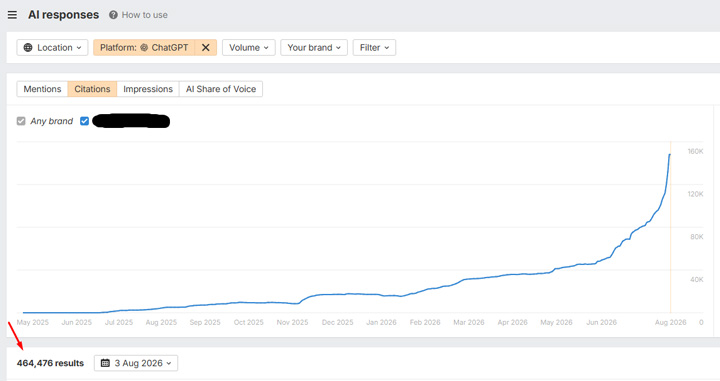
In addition, I thought that maybe ChatGPT was caching Bing results, which could be why the site was still being cited heavily even after being deindexed, but that idea just got shot down. I’m now seeing very recent articles being cited in ChatGPT and that’s AFTER Bing completely deindexed the site. So the cached theory doesn’t hold up.
So what the heck is going on?
There could be several possible scenarios at play right now. I’ll list them below.
- OpenAI might be building its own search index so rankings in Google or Bing don’t matter (for prompts where OpenAI is leveraging its own index). I have no idea if that’s the case, but it’s very possible. I have said all along that there’s no way OpenAI can continue to rely on third-party companies for its search index. That’s a dangerous game that can end very badly for OpenAI. If this is the case, then there are important implications from a quality perspective (like we are seeing with this case study). OpenAI doesn’t have the experience that Google and Bing do fighting spam, building core systems for evaluating quality, understanding authority, and more.
- OpenAI could be grounding its answers via other search platforms. I checked Google, Bing, Yahoo, Duckduckgo, and Brave, and the site is not ranking well in any of them. And for the ones that leverage Bing, nothing is indexed there (which makes complete sense). But, maybe ChatGPT is using another source to ground their answers. I’ll reach out to OpenAI to see if they can share something about this. But don’t hold your breath. OpenAI hasn’t shared much at all regarding the sources they leverage for grounding (other than saying Bing is an official partner). And we know Bing is not the reason the website in my case study is being cited heavily right now.
- OpenAI might be caching results from Bing and then trusting the sites in those cached results based on historical rankings. That could be a reason why the site continues to be cited (and even new articles are being cited). Maybe caching is on a monthly basis or some other interval. Bing nuked the site from its index on July 10, 2026, so that’s less than one month ago. To be honest, I can’t imagine this scenario is what’s happening, but it’s possible so I wanted to document it.
Moving Forward: The Search Continues For Why This Is Happening (pun intended).
To recap this update, we have a website with no Google visibility, Bing deindexed the entire site, and it doesn’t rank in other search engines like Yahoo, Duckduckgo, or Brave. I’m going to reach out to OpenAI to see if they can share anything about how this is happening, how the spammy website is being cited so well, and how they are grounding their answers.
Note, if you want to read the original case study, it’s below (after the July 10 update). I recommend doing that to get up to speed on the entire situation. Stay tuned, this case study just took a right turn.
Update: July 10, 2026
Bing finally deindexed the entire site I covered that had no visibility in Google, yet was ranking very well in Bing (and then downstream in ChatGPT). After my post was published, I was interested in seeing how Bing would respond, and respond it did. The site was completely deindexed on July 10, 2026. I shared about that across social media when it happened (see below). And then it was time to see how citations in ChatGPT were impacted. I’ll cover more about that soon. It’s super interesting…
You can read the original post and case study below.
I came across a very interesting example last week of a YMYL site surging like mad in ChatGPT, yet it had little to no visibility in Google. That’s not something you see every day, so I had to dig in. Since ranking well in Google can often yield strong results downstream at AI Search platforms like ChatGPT, seeing a site that’s non-existent in Google, but with a ton of citations in ChatGPT, was super interesting to me.
I have previously covered that sites heavily impacted in Google (either positively or negatively) can drop or surge in ChatGPT as well. That’s because ChatGPT partly grounds its answers via Google Search (among other sources). More about that soon… But Google is one of the (undocumented) sources. You can read my case study about “Mt. AI” to see a great example of a site with a manual action in Google that also tanks in ChatGPT at the same time. And Lily Ray wrote a post covering sites that dropped with the unconfirmed January 2026 update that also dropped in ChatGPT. I have also shared many examples across social media of this happening.
So like I’ve said many times, if you drop in Google, you can drop in AI Overviews, AI Mode, and downstream at AI search platforms like ChatGPT.
That’s why this case was so interesting… The site is essentially dead in Google, yet surging like crazy in ChatGPT. Also, there’s been a lot of chatter about OpenAI building its own index, which I believe they need to do at some point. So, was this a smoking gun proving that ChatGPT is grounding answers based on its own index or was ChatGPT grounding via other sources? I dug in to find out.
A Recent Surge in ChatGPT For YMYL Prompts:
When checking the YMYL site that has surged in ChatGPT, it was filled with AI-generated content, no contact information, nothing about the authors, nothing about the company behind the site, etc. And it was booming with citations in ChatGPT.
Here is trending of ChatGPT citations for the site:
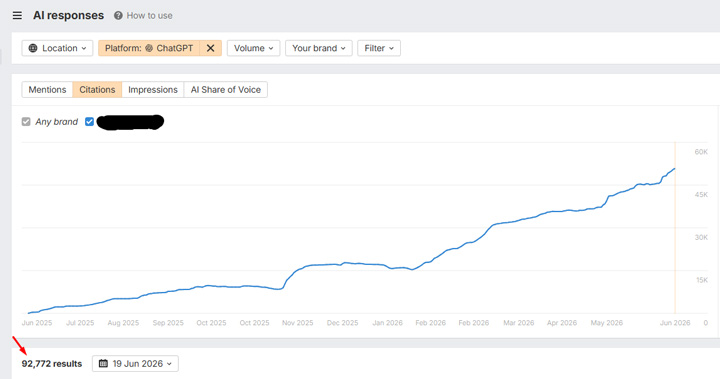
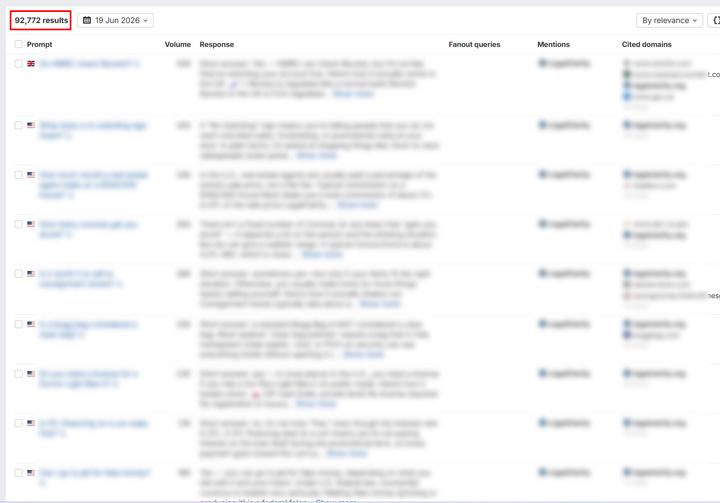
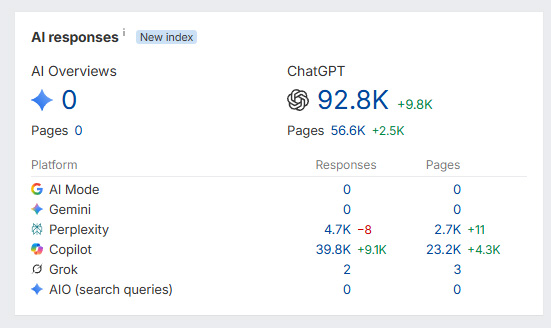
That’s right, Brand Radar shows that the website is being cited in over 90K prompts in ChatGPT now. That was interesting, so I immediately checked Google search visibility. I was expecting to see that surge recently too. But nope, the site has barely any search visibility in Google. Very interesting…
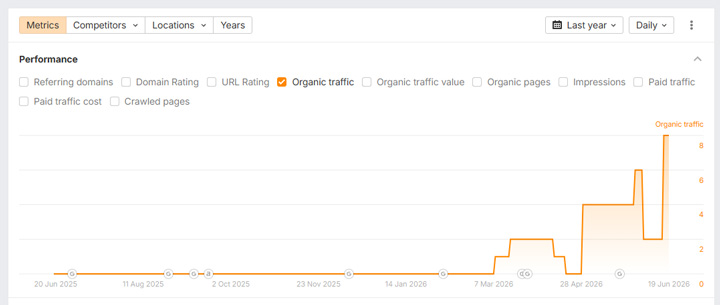
And the site has no visibility in AIOs or AI Mode either (which makes sense based on the lack of visibility in Google’s 10-blue links):
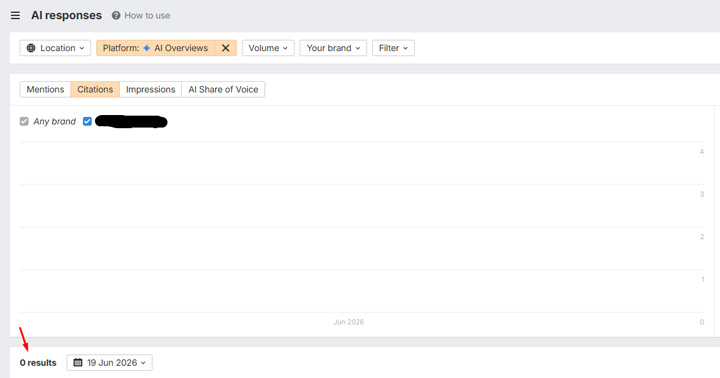
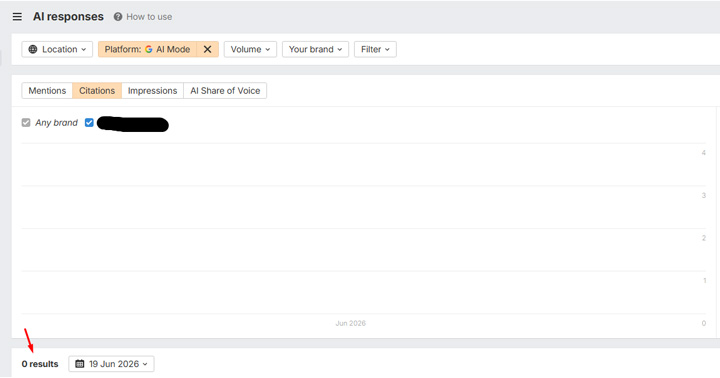
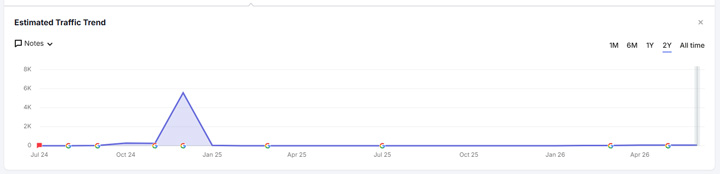
Note, Semrush has picked up more queries the site ranks for, but there aren’t many and the site ranks beyond page seven or eight for most of the keywords. So again, it’s pretty much invisible in Google from a search visibility standpoint. And look, it’s another “Mt. AI” sighting… See late 2024 in to early 2025 below.
Evidence of an OpenAI index or is ChatGPT grounding those answers via other sources?
So how is this happening? Again, most sites being cited heavily in ChatGPT are doing well in Google as well. That’s because ChatGPT can ground answers via Google Search (at least partly). As you saw earlier, Google’s systems already have determined the site should not rank for sensitive YMYL queries, but clearly some other sources believe it should.
It’s been hard to find sites with a lot of visibility in ChatGPT without a lot of visibility in Google, so I started checking other search engines that ChatGPT could use for grounding to see how the site was performing there. The obvious first move was to check Bing.
Bing is still important for grounding (clearly):
We know that Bing is an official search partner of OpenAI and is used for grounding answers, so I checked there first. And yep, the site was ranking for many of the prompts where it was also cited in ChatGPT. Spot-checking Google yielded no rankings for those queries at all, and I checked a few other search engines for the heck of it like Brave Search and Duckduckgo. I saw mixed results there, so it definitely seems like Bing is what ChatGPT is using to ground the answers (for 90K+ prompts).
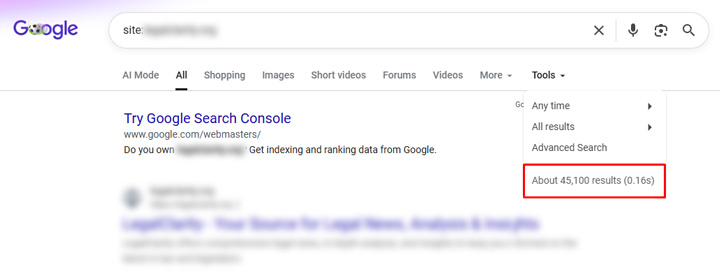
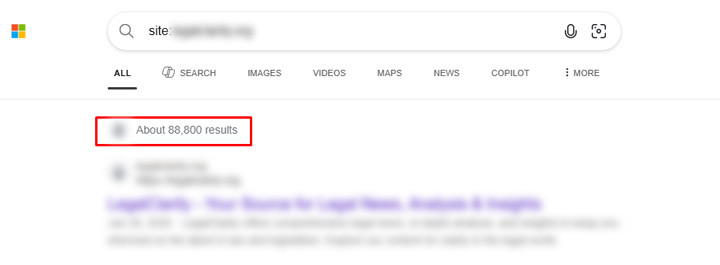
Indexing-wise, Google has indexed over 45K+ urls even though the site has no visibility there. And Bing has indexed 88K+ urls, but Bing can often show higher indexing numbers for sites. Regardless, both search engines are indexing the site well, but Bing is the one rewarding the site rankings-wise (even though I’m not sure it should be.) And those rankings in Bing are helping the site be cited heavily downstream in ChatGPT.
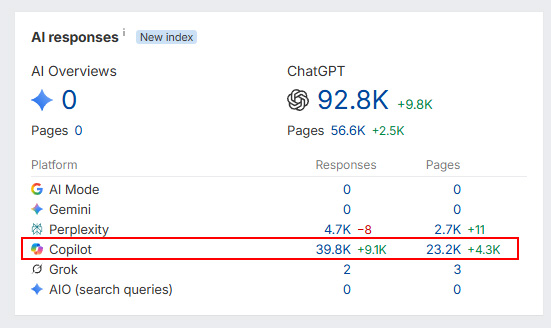
And you might have picked this up earlier, but you can see Copilot citations are very strong… which makes complete sense if Bing organic rankings are very strong.
Net-net: Organic Search performance is still important and performing well in at least one major search engine is still necessary:
So in my opinion, this still means you should look to perform well in organic search to perform well in ChatGPT, but Bing was the driver for this example. Also, I think this case is an odd one since the site is scaling like crazy with AI-generated content, it’s not authoritative even though it focuses on YMYL topics, there’s no information about the authors or company, etc. So, I’m not sure the site should be performing well in Bing (or anywhere).
And with over 45K urls indexed in Google and 88K+ in Bing, I’d say this sure looks like scaled content abuse to me… It will be interesting to see how this goes over time for the site in Bing… There’s already very little visibility in Google and I can see that potentially happening in Bing as well as its core systems adjust.
Summary: No Google Visibility, But Strong Bing Visibility Yields Many Citations In ChatGPT.
We’ll see if the site continues to perform well in Bing over time. I would hope Bing’s systems would eventually understand what’s going on and we’ll see the site drop over time (especially for sensitive YMYL queries). And if that happens, ChatGPT citations should drop as well. I’ll update this post if anything changes on that front. But again, a very interesting AI Search case.
GG