
Ever since ChatGPT launched in November 2022, marketers have tried to understand if being visible in AI Search requires the same type of strategy and tactics as being visible in organic search. In other words, is what you were doing for SEO enough for AI Search or AEO/GEO or are there unique things you need to do in order to be visible across AI search platforms?
The debate continues with some saying it’s the same as SEO, some saying it’s mostly like traditional SEO, and then others saying it’s completely different (or at least very different). In my opinion, and I’ll cover more about this soon, much of what you should have been doing for SEO would cover what you need to do for AI Search. I have seen this with many of my clients that have strong search visibility and I’ve seen that with a lot of my own work covering SEO, Google algorithm updates, AI Search and more.
In addition, AI search leverages RAG (retrieval augmented generation) which taps into Search to ground AI responses. I’ll cover more about RAG in the post, but that means AI Search can tap into Google Search, Bing Search, or other search engines to ground AI answers. That’s important to understand when discussing AI search visibility.
But the point of this post is not to focus on my personal opinion. Instead, it’s to provide a central location to view all the information we have learned so far directly from the AI search platforms about what site owners need to do in order to be visible on those platforms.
Information Directly From The Source: Google, Microsoft, and Others Chime In.
When clients ask me about AEO, GEO, and how that relates to what they have been doing for SEO, I like to take an approach that I’ve used for a long time. I mix my decades of experience working on large-scale and complex sites with information directly from the search engines. Then you have a ‘boots on the ground’ view along with what the search engines have explained about how their systems work. That combination can be very powerful.
For example, you can read my post about Google’s site-level quality evaluation to see the combination of my experience helping many large-scale and complex sites mixed with information directly from Google about how their systems work. That post combines Google quotes, videos, patents, and more to support the fact that Google has a site-wide quality evaluation that can have a big impact on sites when major algorithm updates roll out. I used what I call the “Gabeback Machine” to document the history of that topic and I am doing the same here for AI Search.
So for this post, I wanted to provide a central location where site owners can read what the actual AI platforms are saying about what site owners need to do in order to be visible across AI Search platforms and surfaces. For example, AI Overviews, AI Mode, ChatGPT, Perplexity, Copilot, Gemini, and Claude.
Since AI search is in its infancy, there unfortunately aren’t quotes from every company involved yet (cough, OpenAI), but there is some great information from Google and Microsoft, along with some information from Perplexity as well. I’ll cover all of that below. In addition, I will continue to add to this blog post as more information is shared. So you can think of this as a living document containing information shared from the major players in AI about how AI search works and how to be visible across AI Search platforms.
Let’s get started.
Google’s Jeff Dean about AI Search visibility:
First up, I shared a great video across social media from Jeff Dean, Google’s Chief AI Scientist at Google DeepMind and Google Research, where he joined the Latent Space podcast to speak about Gemini, AI search, and more. Jeff is literally one of the leading minds in AI and has been for a very long time. He’s been at Google since 1999.
In the interview, he was asked how LLM search works versus traditional search. He provided a great rundown of how traditional search works and how AI search is very similar. As Jeff said, it’s not entirely different from how classic ranking and retrieval works.
From Jeff: In traditional Search: “You identify a subset of them (pages) that are relevant with very lightweight kinds of methods. You’re down to like 30,000 documents or something. And then you gradually refine that to apply more and more sophisticated algorithms and more and more sophisticated sort of signals of various kinds in order to get down to ultimately what you show, which is the final 10 results or 10 results plus other kinds of information.”
And then for an LLM-based systems: “And I think an LLM-based system is not going to be that dissimilar, right? You’re going to attend to trillions of tokens, but you’re going to want to identify what are the 30,000-ish documents that are with the maybe 30 million interesting tokens. And then how do you go from that into what are the 117 documents I really should be paying attention to in order to carry out the tasks that the user has asked me to do?”
Here’s my tweet about that ant then the video segment:
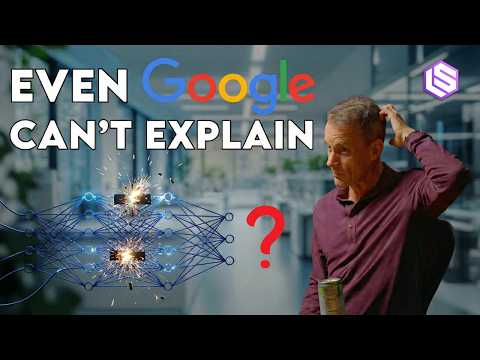
Google’s Danny Sullivan covering SEO versus AEO at WordCamp:
Danny explained that what you are doing for SEO generally covers what you are doing for AEO, GEO, or whatever acronym you want to use. Again, I use the term “AI Search” but AEO is also fine in my opinion.
From Danny: “Good SEO is good GEO, or AEO, AI SEO, LLM SEO, or LMNOPEO. What you’ve been doing for search engines generally is still perfectly fine and the things you should be doing.” and “People will tell you have to make sure you have this vector thingy that’s doing the passage thingy, and it’s just like uhhhhh…” Barry covered the video on Search Engine Roundtable.
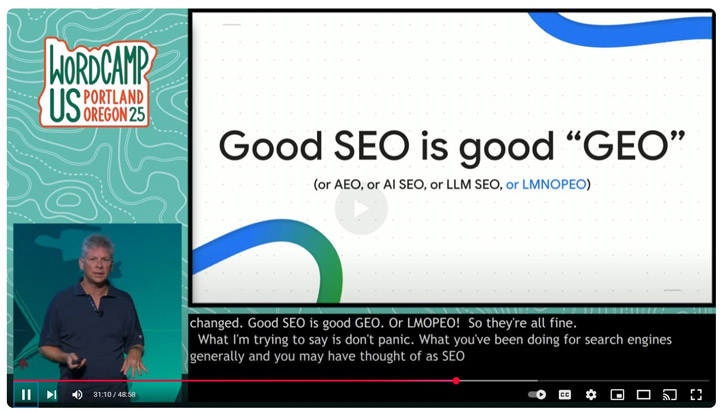
Here is my tweet about that along with the video:

Google’s John Mueller and Danny Sullivan cover SEO versus AEO/GEO in a two-part series on the Search Off The Record podcast:
John and Danny explained that what you have been doing for SEO should cover ranking in AI Search like AIOs, AI Mode, etc.
Part one:
As I explained on X, Danny and John said that traditional SEO is the same optimization for AI Search. If anything, AEO/GEO would be a subset of SEO, under SEO. It is still SEO but the format is different.
Here is my tweet covering the first episode and a link to the YouTube video where Danny covers the topic:

And Barry provided a great post covering the episode including how you should write for users and not to just rank in AI Search. You should focus on originality of your content, which again, is not new. John and Danny also explain how people are seeing original content, videos, podcasts, first-hand experience from forums, and more.
Anyway, you can read Barry’s post covering part one of the podcast, but the core point here is that both John and Danny said that optimizing for AI Search should not really be different than what you are doing for SEO. And that AI Search would be subset of SEO.
John and Danny weren’t done. SEO vs. AEO/GEO Part Two:
And with part two of the podcast series, John and Danny talk more about implementing tactics for AI Search that either aren’t necessary, or that can potentially get you in trouble down the line. Or at best, Google’s systems (and other AI Search platforms) could evolve and all of those things you implemented to try and rank in AI Search might not carry through anymore.
As one example, Danny covers how some people are saying to chunk your content. In other words, turning your content into bite-size chunks because LLMs like things that are really bite-sized. He emphasized that Google really wants site owners to NOT do that. Danny spoke with some search engineers at Google about that advice and said, “we really don’t want you to do that… we really don’t.”
A quick note from me about “chunking”: The idea of breaking your content into logical sections, paragraphs, with headings, bullets, etc., is NOT new. Writers should have been doing that anyway, and for a long time. So Danny isn’t saying to write a wall of text. He’s just saying to not overthink things to the point where your content doesn’t sound right, doesn’t flow well, etc. I totally agree.
Here’s my tweet about the second episode and a link to the episode on YouTube. Again, the entire episode is about the topic:

A Quick Warning From Me:
I’ll add that you could get your site in trouble if you implement risky and spammy tactics to rank in AI Search… For example, receiving a manual action or being impacted by an algorithm update. On that note, the late January 2026 unconfirmed update by Google seemed to address some of those things already as many sites were heavily impacted that were scaling low-quality content to rank in AI Search, including self-serving listicles.
To me, that update looked like a reviews update and many sites were hit hard. And again, some of them were pushing the limits when over-optimizing for AI Search. You can watch my video about the update on YouTube and you can read Lily Ray’s outstanding post about what happened.
Business Insider Interviewed Google, Microsoft and Perplexity:
Moving on, in November 2025 Business Insider interviewed representatives from Google, Microsoft, and Perplexity about GEO. In that interview, each of the people interviewed explained that optimizing for AEO or GEO is very similar to what you should be doing for SEO. Barry covered this on Search Engine Roundtable as well.
Google’s Danny Sullivan, who I have already heavily covered, explained you should be writing for humans and making sure what you publish is useful for humans. He said that any GEO tools that advise designing content solely for rank and visibility purposes lose track of the big picture.
He went on to say that “the core principles of SEO generally apply to new forms of AI Search. General website and structured data hygiene always make sense, ensuring Google’s search crawlers can actually get to the relevant content, especially as AI answers still have a lot of traditional search results at their core.”
Then Microsoft’s Krishna Madhavan, principal product manager for Bing, said “be skeptical of shortcuts”. He explained the fundamentals of SEO are still critical, including structure and freshness signals that make content easier to consume. “Similar to SEO, AI systems rely on fresh, highly ranked, and trustworthy content.”
Krishna mentioned Q&A sections, sitemaps, and schema, and then IndexNow which is a protocol that enables sites to let search engines know when content has changed. And then he added that walls of text are not great, that site owners should keep punctuation simple, and more. I’ll cover more about Krishna’s recommendations soon since he wrote a separate article covering AI Search.
And finally as part of that interview, Perplexity’s head of communications Jesse Dwyer explained optimizing for AEO is somewhere in the middle of the debate… He said, “the biggest mistake you can make is to just try and transfer your understanding apples to apples and a lot of the companies offering GEO services are doing just that.” He also explained that building a brand is super important.
By the way, I totally agree with him about the importance of building a brand for AI search visibility and have explained that several times in the past. i.e. Avoiding shortcuts to rank in AI search is smart and how building your brand to be synonymous with the services or products you provide is powerful. In other words, do real business stuff and good things can happen in traditional search and AI search.
Google’s Nick Fox (SVP of Knowledge and Information) on the AI Inside podcast:
Next up, Google’s Nick Fox was interviewed on the AI Inside podcast and covered optimizing for AI Search. In a nutshell, he said it’s the same as what you would do for optimizing for web search and Google Search. It is SEO. Here is more of what I shared about the episode on X:
“It is SEO” -> “On optimizing for AI Search, Nick Fox said it is “the same” as what you’d do for optimizing for web search and Google Search, it is SEO. Build great sites and great content he said. Nick Fox said, “the way to optimize to do well in Google’s AI experiences is very similar, I would say, the same as how as how to perform well in traditional search. And it really does come down to build a great site, build great content.”
Here’s the video segment where Nick covers the topic:

Google’s Gary Illyes About Ranking in AI Overviews:
Next up, Google’s Gary Illyes explains that to rank in AI Overviews, simply use normal SEO practices. “You don’t need GEO, LLMO, or anything else.” And then Google’s John Mueller shared about that on Bluesky with a meme from Mark Williams-Cook about GEO and SEO.
And here is my tweet about this linking to a LinkedIn thread from Kenichi Suzuki who was there when Gary covered the topic:
And finally, I will cover two articles from Microsoft on the topic of AEO and GEO. The first is from Krishna about optimizing your content for inclusion in AI Search.
Microsoft’s Krishna Madhavan on Optimizing Your Content for Inclusion in AI Search Answers:
Krishna, Principal Product Manager at Bing, provided more details and specific tactics about being visible in AI Search. His focus is on providing “clear, current, comprehensive content that AI systems can surface with confidence.”
He also underscores that “traditional SEO fundamentals still matter. Crawlability, metadata, internal linking, and backlinks remain essential for ensuring your content is discoverable. But they’re just the starting point.”
From a content standpoint, Krishna explains that AI assistants like Copilot break content down parsing it into smaller, structured pieces. And once broken down, those pieces can be evaluated “for authority and relevance.” Then he touches on schema markup. He says, “schema can label your content as a product, review, FAQ, or event, turning plain text into structured data that machines can interpret with confidence.”
My two cents about schema markup and AI Search: There’s a lot of debate about how important schema markup is for AI visibility (and as you can see, Microsoft mentions schema in that article and elsewhere). I’ve always said that adding schema markup is smart to do when it makes sense, but I don’t believe it’s a massively important factor for ranking in AI search. But again, add schema where it makes sense just like you should have been doing for SEO purposes.
And then Krishna ends with what he calls core practices for AI search visibility. That includes:
- Traditional SEO is still essential: Ensure crawlability, metadata, and internal linking remain the baseline.
- Structure your content: Use schema, clear headings, and modular layouts.
- Write with clarity: Be precise in language, context, and punctuation.
- Make answers ‘snippable’: Use concise, self-contained phrasing in lists, Q&As, and tables.
Microsoft Advertising: AI Search Demystified:
And the second publication from Microsoft is from their advertising side and was a marketers guide to AI search. It’s essentially a blueprint for that explains how AI search works, which actions help you show up in answers, and more. For this article, I’ll focus on what the document says about AI search visibility. And as you can guess, it closely follows what Krisha explained above. There are also quotes and information from several SEO industry veterans like Aleyda Solis, Lily Ray, Mike King, and Britney Muller.
Some key points from the pdf include:
Grounding via RAG and the importance of a strong search index backing responses: “One of the solutions to this problem is Retrieval Augmented Generation (RAG), which connects LLMs to external information retrieval resources (like Bing) to provide an LLM with additional relevant, up-to-date, and accurate information to improve outputs. In search, we call this type of RAG ‘grounding’. Grounding ensures that answers from LLMs are more accurate and trustworthy and can reference fresh information that goes beyond pre-trained data. The search index plays a critical role in grounding.”
About organic visibility in AI answers (again, emphasizing how AI experiences build on traditional SEO foundations):
“In AI-assisted journeys, brands appear organically within AI snippets and conversational responses synthesized from trusted web sources. These experiences build on traditional SEO foundations, using indexed content as a starting point and layering in additional signals as answers are assembled.”
The document covers common mistakes that hurt AI search visibility:
- Long walls of text.
- Hiding important answers in tabs or expandable menus.
- Relying on PDFs for core information.
- Key information only in images.
On the importance of traditional SEO:
“Traditional SEO remains essential to being visible in AI search because AI systems perform real-time web searches frequently throughout the shopping journey, not just at purchase time, and your site must rank well to be discovered, evaluated, and recommended.”
About publishing clear, structured content (emphasizing this isn’t new…)
“Clear, well-structured content that’s easily readable for web crawlers isn’t a new tactic for success. However, in the world of GEO, clarity goes beyond just word choice and into how you phrase, format, and punctuate so AI systems can interpret your content with confidence.”
“AI systems don’t just scan for keywords. They look for clear meaning, consistent context, and clean formatting. Precise, structured language makes it easier for AI to classify your content as relevant and lift it into answers.”
About writing mistakes that reduce AI search visibility:
- Overloaded sentences.
- Decorative symbols (like arrows, stars, or strings of punctuation that distract from the actual content).
- Unanchored claims (like saying something is “next-gen” or “cutting-edge” withtout context.
Summary: AI search is evolving quickly. This document will evolve as well.
I hope this blog post helped you understand more about what the various AI search platforms have explained about AI search visibility. For example, how to make sure your brand and content is visible, how SEO is the foundation for AI search, how RAG works, and more. The AI search platforms will continue to evolve quickly and I will add more information to this document as time goes on (as we learn more directly from the source). So if any of the major AI search platforms reveal more information about how their systems work, I will include it here. And I hope that includes OpenAI… Stay tuned.
GG